Skip to content
Create an Accounts Enable Guest Account Status Policy with help of Intune

Create an Accounts Enable Guest Account Status Policy with help of Intune

Written By Abhinav Rana
Last Updated June 26, 2026
Posted In Intune
SHARE

This article is written to take you through the process of implementing the Intune Guest Account Status Policy. We’ll make use of Intune’s Settings Catalog to enforce this policy, emphasizing a practical, hands-on approach to make you understand the Guest Account Status Policy in action with Intune.

Guest Account Status Policy configuration establishes the status of the Guest account, indicating whether it is enabled or disabled. By default, it is set to Disabled.

It’s important to note that if the Guest account is disabled and the security parameter “Network Access: Sharing and Security Model for local accounts” is configured to Guest Only, certain network logons, such as those executed by the Microsoft Network Server (SMB Service), will encounter failures.

The default Guest account permits network users without authentication to log in as Guest without requiring a password. Such unauthorized users may gain access to resources available to the Guest account across the network.

Patch My PC

This functionality implies that any network shares with permissions granting access to the Guest account, the Guests group, or the Everyone group become accessible over the network. This situation poses a risk of data exposure or corruption.

Guest Account Status Policy with the help of Intune Fig.1

Guest Account Status Policy with the help of Intune

To implement Guest Account Status Policy with the help of Intune, follow the steps stated below:

  • Sign in to the Intune Admin Center portal https://intune.microsoft.com/.
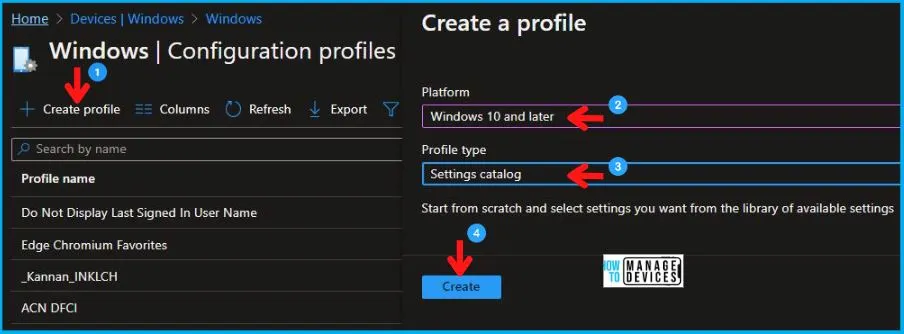
  • Select Devices > Windows > Configuration profiles > Create a profile.

In Create Profile, I select Windows 10 and later in Platform, and select Profile Type as Settings catalog. Click on the Create button.

PlatformProfile Type
Windows 10 and laterSettings Catalog
Table 1 – Guest Account Status Policy with the help of Intune
Guest Account Status Policy with the help of Intune Fig.2

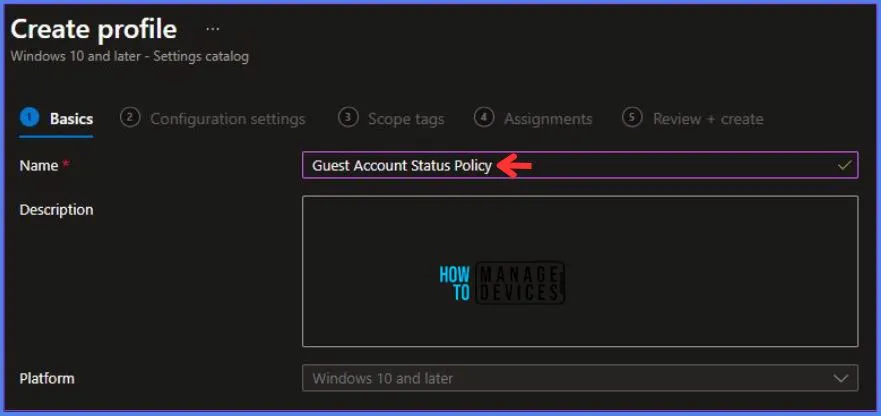
On the Basics tab pane, I provide a name for the policy as “Guest Account Status Policy.”

  • Optionally, if you want, you can enter a policy description and proceed by selecting “Next“.
Guest Account Status Policy with the help of Intune Fig.3

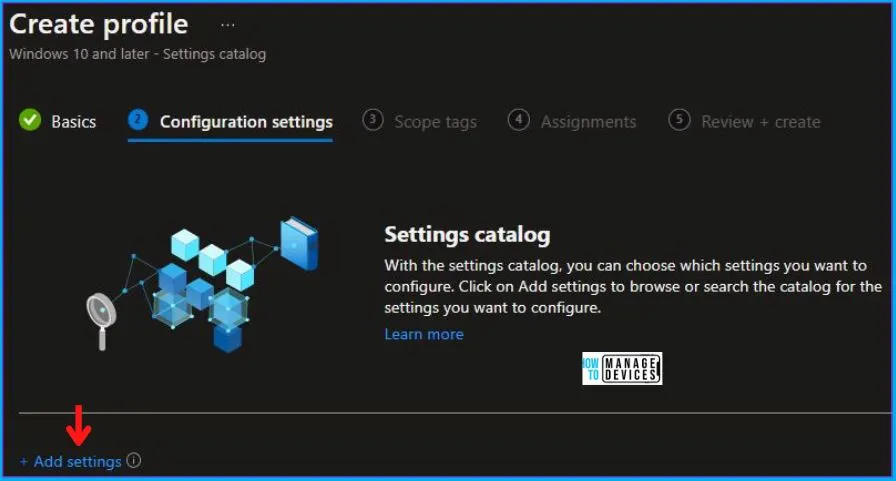
Now in Configuration Settings,

  • Click Add Settings to browse or search the catalog for the settings I want to configure.
Guest Account Status Policy with the help of Intune Fig.4
  • In the Settings Picker windows
  • I searched for the keyword Guest
  • I found the category Local Policies Security Options and selected this

When I select that option as stated above, I see the sub-category Accounts Enable Guest Account Status. After selecting that, click the cross mark at the right-hand corner, as shown below.
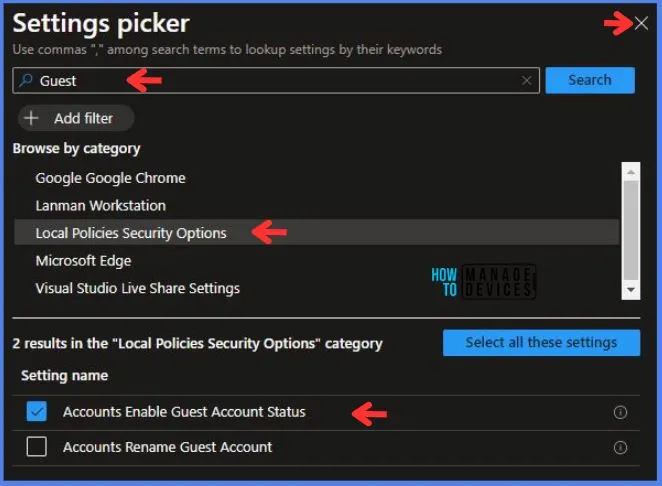
Guest Account Status Policy with the help of Intune Fig.5

Here I choose disable for Accounts Enable Guest Account Status in Local Policies Security Options.
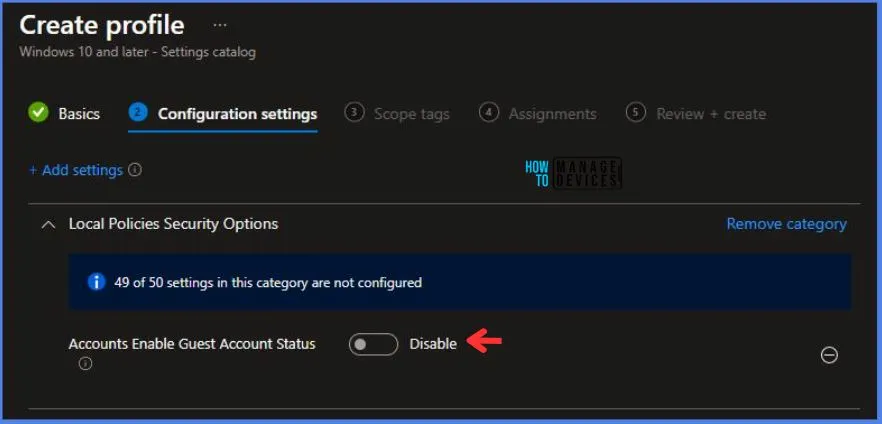
Guest Account Status Policy with the help of Intune Fig.6

Using Scope tags, you can assign a tag to filter the profile to specific IT groups. One can add scope tags (if required). More details on Intune Scope Tags Implementation Guide.

  • Click Next to continue.

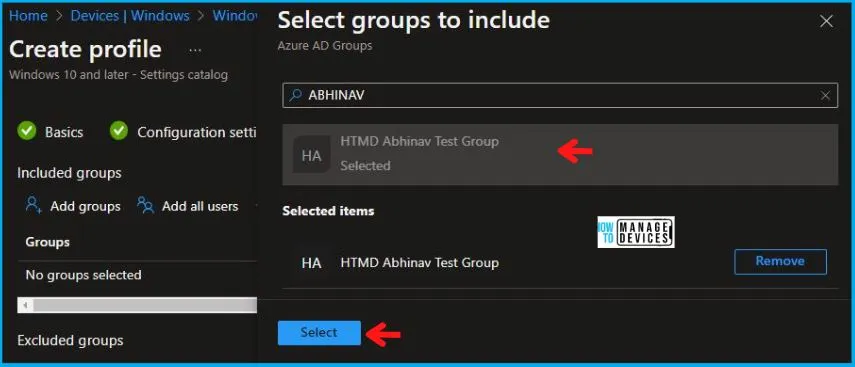
Now in Assignments, in Included Groups, you need to click on Add Groups, and choose Select Groups to include one or more groups to deploy the Guest Account Status Policy.

  • Click Next to continue.
Guest Account Status Policy with the help of Intune Fig.7

In the Review + Create tab, I review settings. After clicking on Create, changes are saved, and the profile is assigned.
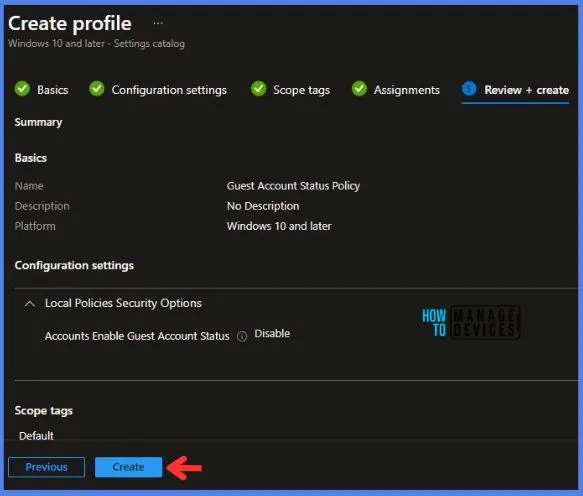
Guest Account Status Policy with the help of Intune Fig.8

After successfully creating the “Guest Account Status Policy,” a notification will appear in the top right-hand corner confirming the action. You can also verify the policy’s existence by navigating to the Configuration Profiles list, where it will be prominently displayed.

Your groups will receive your profile settings when the devices check in with the Intune service. The Policy applies to the device.

Intune Report for Guest Account Status Policy

From the Intune Portal, you can view the Intune settings catalog profile report, which provides an overview of device configuration policies and deployment status.

To track the assignment of the policy, you need to select the relevant policy which is ‘Guest Account Status Policy’ from the Configuration Profiles list. Then, you can review the device and user check-in status to determine whether the policy has been successfully applied.

  • If you require more detailed information, you can click on “View Report” to access additional insights.
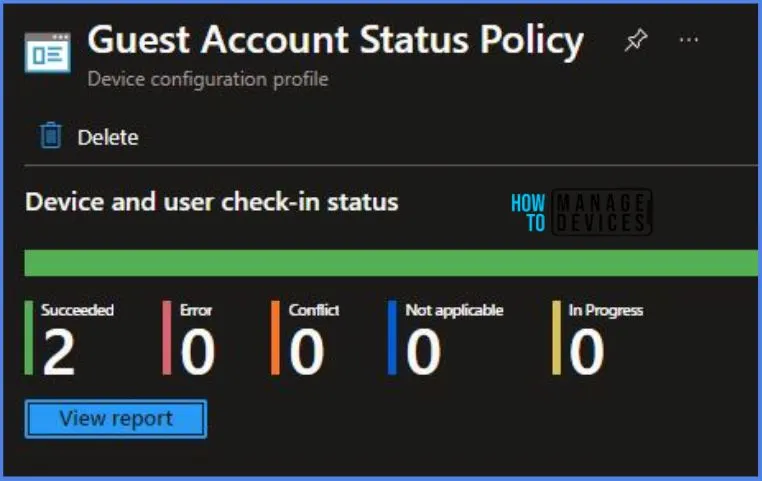
Guest Account Status Policy with the help of Intune Fig.9

Intune MDM Event Log related to Guest Account Status Policy

To verify the successful implementation of String or integer policies for Guest Account Status Policy on Windows 10 or 11 devices through Intune, you can leverage event IDs 813 and 814.

These event IDs provide valuable insights into the application status of the Guest Account Status Policy as well as the specific value assigned to the policy on those devices. In the case of this particular policy, the value is an Integer and is linked to the event ID 813.

By analyzing these event IDs, you can gain a clear understanding of the policy’s application status and the corresponding value associated with it on the devices in question.

To confirm this, you can check the Event log path – Applications and Services Logs – Microsoft – Windows – Devicemanagement-Enterprise-Diagnostics-Provider – Admin.

MDM PolicyManager: Set policy string, Policy: (Accounts_EnableGuestAccountStatus), Area: (LocalPoliciesSecurityOptions), EnrollmentID requesting merge: (5B88AEF1-09E8-43BB-B144-7254ACBBDF3E), Current User: (Device), Int: (0x1), Enrollment Type: (0x6), Scope: (0x0).

Guest Account Status Policy with the help of Intune Fig.10

When I opened the above Event log, I found that the Guest Account Status Policy I have applied to the device has been successfully implemented.

  • By reviewing the log entry shown in the above image, the Event Viewer, I came across essential information, including the Area and Enrollment ID.

These details play a significant role in identifying the corresponding registry path. To locate the specific information, please consult the table provided below:

AreaPolicyIntegerScopedEvent ID
LocalPoliciesSecurityOptionsAccounts_EnableGuestAccountStatus0Device813
Table 2 – Guest Account Status Policy with the help of Intune

The details presented in the table above for the Guest Account Status Policy with the help of Intune can be employed to access the registry settings that hold the group policy configurations on a specific computer. To accomplish this, you can execute “REGEDIT.exe” on the target computer and navigate to the precise registry path where these settings are stored.

  • Computer\HKEY_LOCAL_MACHINE\SOFTWARE\Microsoft\PolicyManager\providers\5B88AEF1-09E8-43BB-B144-7254ACBBDF3E\default\Device\LocalPoliciesSecurityOptions

When you navigate the above path in the Registry Editor, you will find the registry key named Accounts_EnableGuestAccountStatus. Also, when I navigated to the above path, I saw that the Registry Key was created successfully.

Registry NameValue
Accounts_EnableGuestAccountStatusEnabled
Table 3 – Guest Account Status Policy with the help of Intune
Guest Account Status Policy with the help of Intune Fig.11

Windows CSP Details Accounts_EnableGuestAccountStatus

We will see Windows CSP Details for this Policy setting Accounts_EnableGuestAccountStatus. Authentication is required for all network users to access shared resources. If the Guest account is disabled and the Network Access: Sharing and Security Model is configured to Guest Only, certain network logons, including those executed by the Microsoft Network Server (SMB Service), will not succeed.

It’s worth noting that this policy setting is typically the default configuration in Microsoft Windows 2000, Windows XP, and Windows Server™ 2003, and, as such, should have minimal impact on the majority of organizations.

CSP URI – ./Device/Vendor/MSFT/Policy/Config/LocalPoliciesSecurityOptions/Accounts_EnableGuestAccountStatus

Guest Account Status Policy with the help of Intune Fig.12

We are on WhatsApp. To get the latest step-by-step guides and news updates, Join our Channel. Click hereHTMD WhatsApp.

Author

Abhinav Rana is working as an SCCM and Intune Admin with several years of experience. He loves to help the community by sharing his knowledge. He is a B.Tech graduate in Information Technology.

Discussion

Join the discussion

Your email address will not be published. Required fields are marked *

Related guides

Intune

Simplify Windows Devices to Run Only the Required Applications using Intune

Key Takeaways Hey, let’s learn about Simplify Windows Devices to Run Only the Required Applications using Intune. This policy lets administrators replace the default windows shell with a custom or lightweight shell. it improves performance by using system resources and is useful for devices that run a dedicated application. If the policy is disabled or […]

AC Anoop C Nair 8 min read
Intune

Enhance macOS Compliance with Custom Security and Compliance Checks to Improve Device Security using Microsoft Intune

Key Takeaways In this post we are discussing about Enhance macOS Compliance with Custom Security and Compliance Checks to Improve Device Security using Microsoft Intune. Microsoft has announced the general availability of Custom Compliance Settings for macOS in Microsoft Intune. The feature helps organizations strengthen security controls while supporting many types of macOS management scenarios. […]

AC Anoop C Nair 4 min read
Intune

Manage Samsung Galaxy Firmware Versions to Improve Security and Compliance using Microsoft Intune

Key Takeaways In this post we are discussing Manage Samsung Galaxy Firmware Versions to Improve Security and Compliance using Microsoft Intune. Microsoft Intune has received a new update that expands firmware management capabilities for Samsung Galaxy devices through Firmware Versionsintegration. This enhancement gives IT administrators more control over firmware and operating system updates, helping them […]

AC Anoop C Nair 4 min read
Intune

MS Intune Adds Windows Registry Data Collection to Device Inventory for Single Values All Key Values and Subkeys

Key Takeaways Microsoft Intune 2607 introduces Windows Registry Data collection in Device Inventory, allowing IT admins to verify actual device configurations without relying on custom discovery or remediation scripts. Using the Properties Catalog, admins can collect registry information through Single Value, All Values Under a Key (Non-Recursive), or Same Value Across Subkeys. MS Intune Adds […]

AC Anoop C Nair 5 min read