




SCCM How to Resolve Duplicate or Conflict Record Issues ConfigMgr
SCCM How to Resolve Duplicate or Conflict Record Issues ConfigMgr. I have seen many duplicate record-related issues faced by many people in the Forums. William Eriepa explained the problem in the TechNet thread below.
Records that have the same name, different GUID, and various hardware IDs are called Duplicate or Conflict Records. This is usually caused by a machine that already has a record in SCCM, is modified after its initial record creation and generates a new GUID.
Table of Contents
ISSUE – How to Resolve Duplicate or Conflict Record Issues
ISSUE (Credits to William Eriepa) – “Hi. I have an intermittent problem with duplicate records showing up only on computers. The issue seems to be attributed to the different discovery methods that SCCM uses.
- ConfigMgr Reports Power Management | Default
- How To Disable SCCM Application Deployment | ConfigMgr
- Learn How To ConfigMgr SCCM Merge Obsolete Duplicate Records
I’ve read many posts on Technet and other sites but have been unable to find a solution. I’ve checked the related discovery logs and haven’t seen any discovery errors or issues I can discern.

I have a single primary site that uses discovery. My hierarchy is R3. Here are my discovery settings:
| Discovery | Settings |
|---|---|
| AD System Discovery | 2days (5min delta) |
| AD System Group Discovery | 15 minutes (5min delta) |
| Heartbeat Discovery | 8 hours |
| Network Discovery | Disabled |
Duplicate or Conflict Record Issues
The Fundamental Problem is when I Build a New Computer, and sometimes it will do as follows:
1. The computer is built through OSD. Once built, the SCCM client sends a DDR to the Site Server, and a record is created for it.
2. Up to 15 minutes later, when AD Sys Grp Disc runs, the record is populated with the correct AD Group/OU information, etc.
3. Up to 2 days later, when AD Sys Disc runs, a new record is created for the same computer. This record has for most of the fields, including the SMSGUID. Still, it does have the correct AD Group/OU information (i.e., this record was created directly from AD/DNS but is not associated with the computer record already in SCCM).
4. Further, AD Sys Grp Discoveries only updates the new record that isn’t linked to the client.
5. The original record (linked to the actual client) loses the AD Group/OU information it had and is no longer updated by further AD Sys Grp Discoveries. Heartbeat discoveries continue to work as usual.
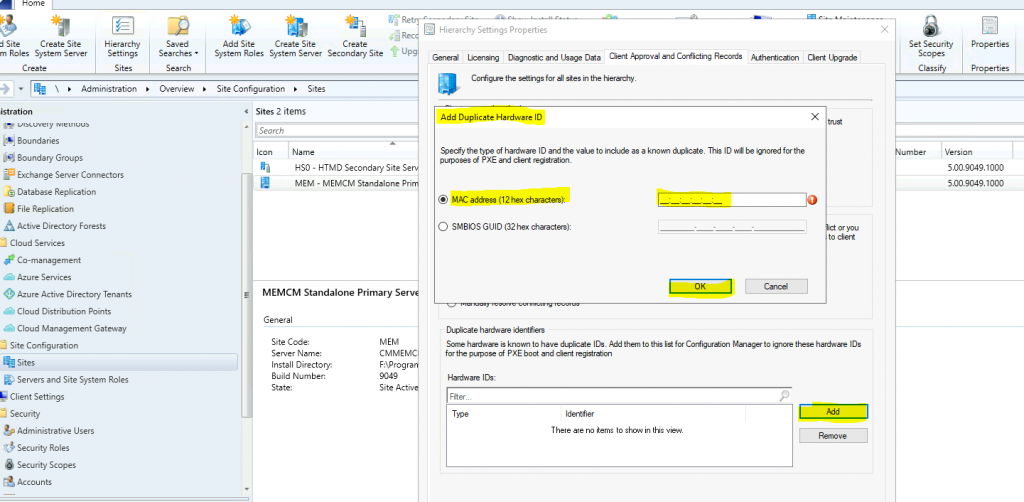
This problem is far from consistent. Recently, I built eight computers, PC01 – PC08, at the same time, but only PC02 experienced this problem. The original record for PC02 was created on 11/03/2011 at 4:53:56pm via the DDR/Heartbeat Discovery.
This record was correctly processing AD Sys Grp Discoveries. Then, another form for PC02 was created on 12/03/2011 at 12:15:35 am via AD Sys Disc. The original record lost its AD Group/OU associations and no longer processed AD Sys Grp Disc.
Deleting the “new” record created by AD Sys Disc results in the “original” form getting the correct AD Group/OU information during the next AD Sys Grp Discovery. So, I do have a way to treat this problem, but I would like to find out how to stop it from happening in the first place.
Workaround – SCCM How to Resolve Duplicate or Conflict Record Issues ConfigMgr
Due to the discovery data manager mechanism, Duplicate Records runs a query and sorts the results by date. It will update the most recent returned result rather than the active result if more than one result is returned.
Any subsequent AD discovery will update the NULL or inactive entry in the database instead of the active entry.
This is a known issue with Microsoft. A workaround is available to remove the duplicate records. The below-mentioned query will identify duplicate records of clients:
Select R.ResourceID,R.ResourceType,R.Name,R.SMSUniqueIdentifier,R.ResourceDomainORWorkgroup,R.Client from SMS_R_System as r full join SMS_R_System as s1 on s1.ResourceId = r.ResourceId full join SMS_R_System as s2 on s2.Name = s1.Name where s1.Name = s2.Name and s1.ResourceId != s2.ResourceId and R.Client = null
Once those duplicates are identified and fetched into the collection, we can delete them using the following process. All future AD group discoveries will update the correct record in the database.
- Create a collection for collecting the duplicate system with a NULL record. Please use the below query.
Select R.ResourceID,R.ResourceType,R.Name,R.SMSUniqueIdentifier,R.ResourceDomainORWorkgroup,R.Client from SMS_R_System as r full join SMS_R_System as s1 on s1.ResourceId = r.ResourceId full join SMS_R_System as s2 on s2.Name = s1.Name where s1.Name = s2.Name and s1.ResourceId != s2.ResourceId and R.Client = null
2. Once the collection is created and records are populated. Right-click and select Delete Special.
3. This will delete all the populated systems in this collection.
We are on WhatsApp. To get the latest step-by-step guides and news updates, Join our Channel. Click here –HTMD WhatsApp.
Author
Anoop C Nair is Microsoft MVP! He is a Device Management Admin with more than 20 years of experience (calculation done in 2021) in IT. He is a Blogger, Speaker, and Local User Group HTMD Community leader. His primary focus is Device Management technologies like SCCM 2012, Current Branch, and Intune. He writes about ConfigMgr, Windows 11, Windows 10, Azure AD, Microsoft Intune, Windows 365, AVD, etc.

thank you for your helpful info. I cleaned my sccm duplicate systems.
Hi Anoop,
i have followed this way and success but I have only one question that, If I create this collection on a central server then it is reflected on a down Primary server but the machines are reflected only Regional level . So after delete from central server . we have to delete from Primary server too. IS this real ??
StaffWhen you delete it from central it should automatically removed from child Primary (in normal scenario).
Love this, thank you for the information. Cleaned out nearly 1700 duplicates!
Hi Anoop
We have a serious problem with this, that iv’e tried to fix for nearly two months now :-/
On a new domain (Department that has been included in SCCM) we often see the duplicate created. Even at fresh installs.
Problem is this:
If the Duplicate is created during the TS-install, the dynamic Application install will fail?
If the Applications do get installed they are only present in the duplicate without client and from SCCM it appears that no software is installed.
Regards
Thomas Ehler
Systems Administrator
Aarhus University
StaffHi Thomas ! – We’ve this issue in CM 12 as well. And we’re using SCCM 2012 OSD TS to build machines. To cater this we’re using 1) Auto approve all the computers 2) Script to merge the duplicate records. Have you already tried to use the script to merge SCCM duplicate records?
Regards
Anoop
Hi Anoop,
I have a different problem. I have multiple computer entries in multiple collections.All of them shows client installed.How can i identify which one is the correct computer and how can i resolve this .
HI,
this query is not working for us getting error- invalid object name ‘sms_r_system”
StaffSelect your SCCM DB instead of master from sql management studio
Hi Anoop, Is this a good way of removing Duplicate GUIDs?
Stop-Service ccmexec
Remove-Item -Path “$($Env:WinDir)\smscfg.ini” -Force -Confirm:$false -Verbose
Remove-Item -Path ‘HKLM:\Software\Microsoft\SystemCertificates\SMS\Certificates\*’ -Force -Confirm:$false -Verbose
Good morning
For information, using the “NULL” condition does not work, however if you use “IS NULL” it works.
select r.ResourceId, r.ResourceType, r.Name, r.SMSUniqueIdentifier, r.ResourceDomainORWorkgroup, r.Client from SMS_R_System as r full join SMS_R_System as s1 on s1.ResourceId = r.ResourceId full join SMS_R_System as s2 on s2.Name = s1.Name where s1.Name = s2.Name and s1.ResourceId != s2.ResourceId and R.Client IS NULL
I am having an issue in sccm where when I reimage and existing machine with the task sequence it keeps failing and displays that no task sequence available for this computer. I searched the smts.log file and deleted all the records from the sccm collection (MAC address, smbios Guid and net bios name) but it still keeps failing. Any advice on house to fix this. The sccm site is set to automatically resolve duplicate entries