Skip to content
Create SCCM Query Find Device From BIOS GUID

Create SCCM Query Find Device From BIOS GUID

Written By Jitesh Kumar
Last Updated June 14, 2022
Posted In SCCM
SHARE

Let’s find out the easiest method to create SCCM Query to find device from BIOS GUID. You can create and run queries to locate devices in a Configuration Manager hierarchy that match your query criteria.

Many times identify the computer with BIOS GUID to help you quickly resolve the issue by correctly cleaning the client that stole the GUID. That’s helpful, especially during the imaging process, when the task sequence failed at WinPE.

There are seventeen (17) default or out-of-box WQL queries available in the Configuration Manager console itself. I have many posts that explain the WQL queries and dynamic collections. I have explained how to Create SCCM dynamic device Collection for Visual Studio Upgrade using a WQL query.

The WQL queries are extremely powerful, and you must be very careful about the performance side of WQL queries. You can follow the explained best practices that you will need to keep in mind while building the queries. There is an option to validate the dynamic query, and it’s beneficial.

Patch My PC

Most of the default WQL queries are useful. However, some of them are not really useful for most scenarios, In the below section, you will find out the steps to Create SCCM WQL Queries.

Create SCCM Query Find Device From BIOS GUID

The following points help you to create queries to find the device from BIOS GUID in Configuration Manager –

In the Configuration Manager console, select Monitoring. Select Queries, Right-click on Queries, and choose Create Query.
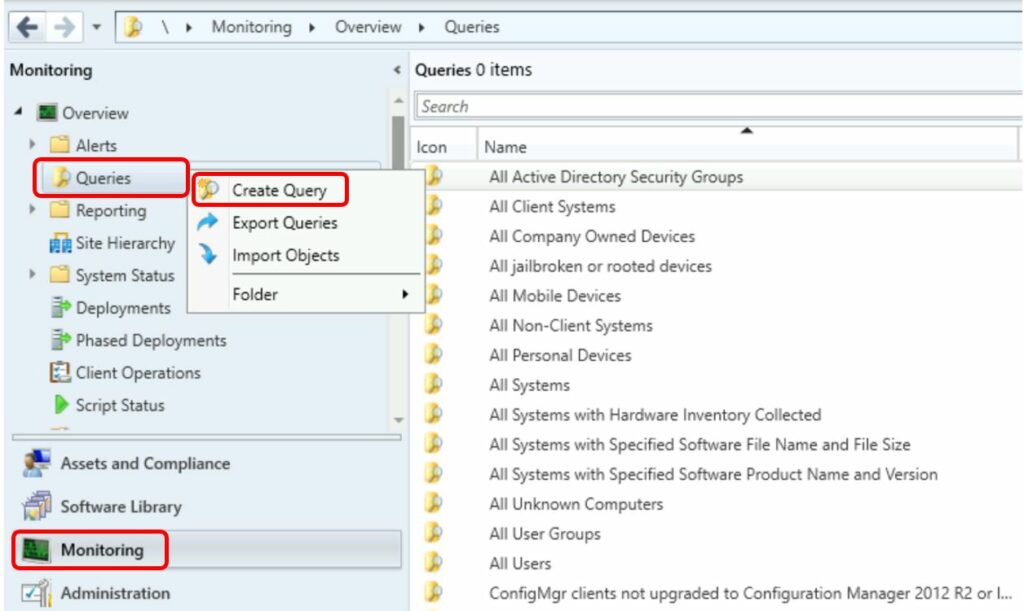
Select Create Query - Create SCCM Query Find Device From BIOS GUID 1
Select Create Query – Create SCCM Query Find Device From BIOS GUID 1

On the General tab of the Create Query Wizard, specify a unique name and, optionally, a comment for the query.

Click on Edit Query Statement to open the <Query Name> Statement Properties dialog box.
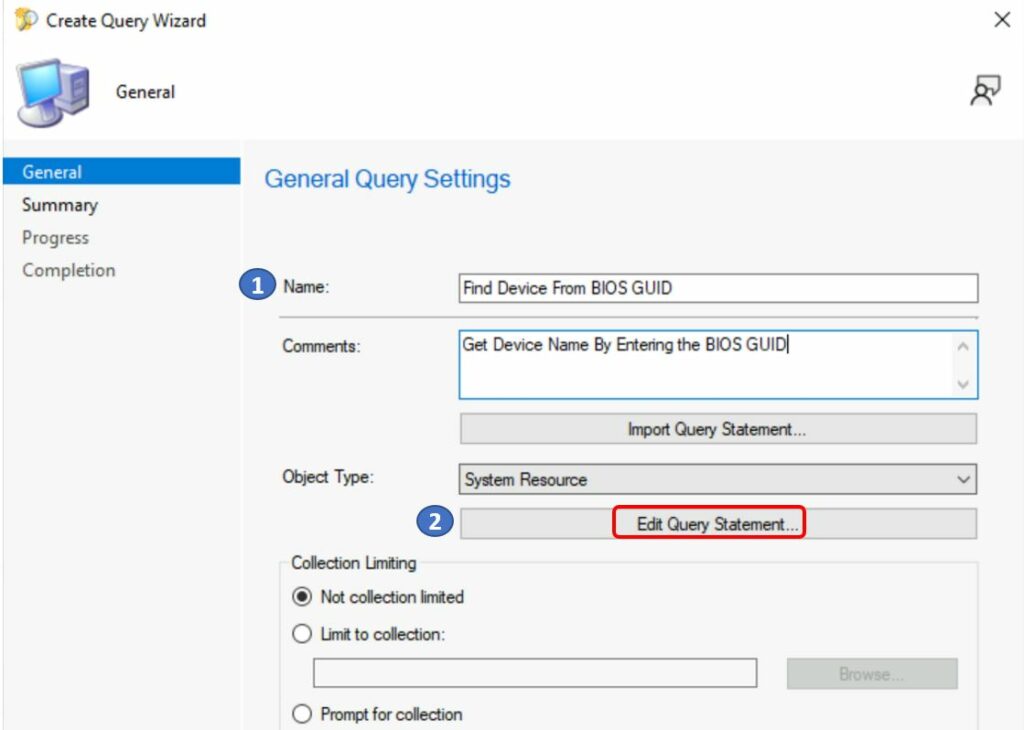
Specify Query Details - Create SCCM Query Find Device From BIOS GUID 2
Specify Query Details – Create SCCM Query Find Device From BIOS GUID 2

Select Show Query Language to enter or edit the query directly in WMI Query Language (WQL).

Click Show Query Language - Create SCCM Query Find Device From BIOS GUID 3
Click Show Query Language – Create SCCM Query Find Device From BIOS GUID 3

In the Query Language, Copy and paste the following WMI Query Language (WQL) and Click OK

select SMS_R_System.ResourceId, SMS_R_System.Name from SMS_R_System where SMS_R_System.SMBIOSGUID like ##PRM:SMS_R_System.SMBIOSGUID##
Specify Query - Create SCCM Query Find Device From BIOS GUID 4
Specify Query – Create SCCM Query Find Device From BIOS GUID 4

On the next screen of Query Settings, Click Next.

On the Summary page, review the details and Click Next to confirm the settings.

Create Query Wizard - Confirm the added values
Create Query Wizard – Confirm the added values

The task “Create Query Wizard” completed successfully. Click Close to finish the wizard.

The task "Create Query Wizard" completed successfully
The task “Create Query Wizard” completed successfully

Once you completed the wizard. The new query appears in the Queries node in the Monitoring workspace. Right-click on the query and select Run, Or you can also double-click on the query to run.

Select the query - Run
Select the query – Run

Here a prompt will appear to Enter the BIOS GUID of the device, which you want to check.

Note – You can collect the SMBIOS GUID for a device under the Summary tab in SCCM Console. To get SMBIOS GUID in a machine.

Enter a value for BIOS GUID

Here you can see the results for Find Device From BIOS GUID displays information for the device.

Results for Find Device from BIOS GUID

Author

Written by

Jitesh has over 5 years of working experience in the IT Industry. He writes and shares his experiences related to Microsoft device management technologies and IT Infrastructure management. His primary focus area is Windows 10 Deployment solution with Configuration Manager, Microsoft Deployment Toolkit (MDT), and Microsoft Intune.

Discussion

Join the discussion

Your email address will not be published. Required fields are marked *

Related guides

Intune

Windows 11 KB5101650 KB5099414 July 2026 Patch and 3 Zero Day Vulnerabilities and 570 Flaws

Key Takeaways Windows 11 KB5101650 KB5099414 July 2026 Patch and 3 Zero Day Vulnerabilities and 570 Flaws! In the July 2026 Patch, Microsoft introduced new features designed to improve the overall Windows experience. The update adds enhancements to Windows Update for more flexible update management and introduces Point-in-Time Restore, providing an additional recovery option for […]

AC Anoop C Nair 9 min read
Intune

2026 June KB5094126 KB5093998 Windows 11 Patch | 3 Zero Day Vulnerabilities and 200 Flaws

Key Takeaways 2026 June KB5094126 KB5093998 Windows 11 Patch | 3 Zero Day Vulnerabilities and 200 Flaws! The June 2026 Windows 11 Patch Tuesday update brings several improvements to File Explorer. It adds support for additional archive formats, including UU, CPIO, XAR, and NuGet Packages (NUPKG). The update also preserves View and Sort preferences in […]

AC Anoop C Nair 10 min read
Intune

2026 May KB5089549 KB5087420 Windows 11 Patch | 0 Zero Day Vulnerabilities and 120 Flaws

Key Takeaways The Windows 11 May 2026 Patch KB5089549 KB5087420 Update brings important security fixes, performance improvements, and reliability enhancements across the operating system. The update introduces new features such as Xbox Mode for gaming, File Explorer improvements, enhanced input and sharing experiences, better taskbar and Windows Hello reliability, and additional enterprise management capabilities for […]

AC Anoop C Nair 8 min read
SCCM

ConfigMgr 2603 Introduces New Early Update Enrollment Process

Key Takeaways In this post we are discussing the ConfigMgr 2603 Introduces New Early Update Enrollment Process. Microsoft has officially released Configuration Manager version 2603 to the Early Update Ring, giving organizations an opportunity to test upcoming improvements before the global production rollout. The release is targeted at enterprises running ConfigMgr version 2409 or later […]

AC Anoop C Nair 3 min read