


Skip to content
Delete Application Deployment from Intune MEM Portal

Delete Application Deployment from Intune MEM Portal

Written By Jitesh Kumar
Last Updated July 7, 2022
Posted In Intune
SHARE

In this post, you will learn how to delete Application Deployment from Intune MEM Portal. If you want to stop the deployment of an application, you can either delete the apps assignment temporarily or delete it entirely.

Deleted app assignments are removed from the company portal from managed devices. When you delete app deployment, This action doesn’t delete the group, any dependencies, or the application itself.

Before adding a Win32 app to Microsoft Intune, you must prepare the app using the Microsoft Win32 Content Prep Tool. You use the Microsoft Win32 Content Prep Tool to pre-process Windows classic (Win32) apps, Intune Win32 App Deployment Step By Step Guide. 

You will learn how to get Application Version Details from Intune Portal, Intune discovered apps is a list of detected apps on the Intune enrolled devices in your tenant. You may find it helpful to assess and understand a few app fundamentals to know the details of the application name and application version.

Patch My PC

The App Install Status report also provides a list of apps with versions and installation details, App installation details include VersionPublisher, and Platform. Let’s check the Intune App Installation Status Report.

Delete Application Deployment from Intune MEM Portal

Here’s how you can delete application deployment from Intune portal. You have two options to navigate to the application node either you can navigate to the All Apps or Apps -> By Platform –

Here you can see the lists of available applications in the portal.
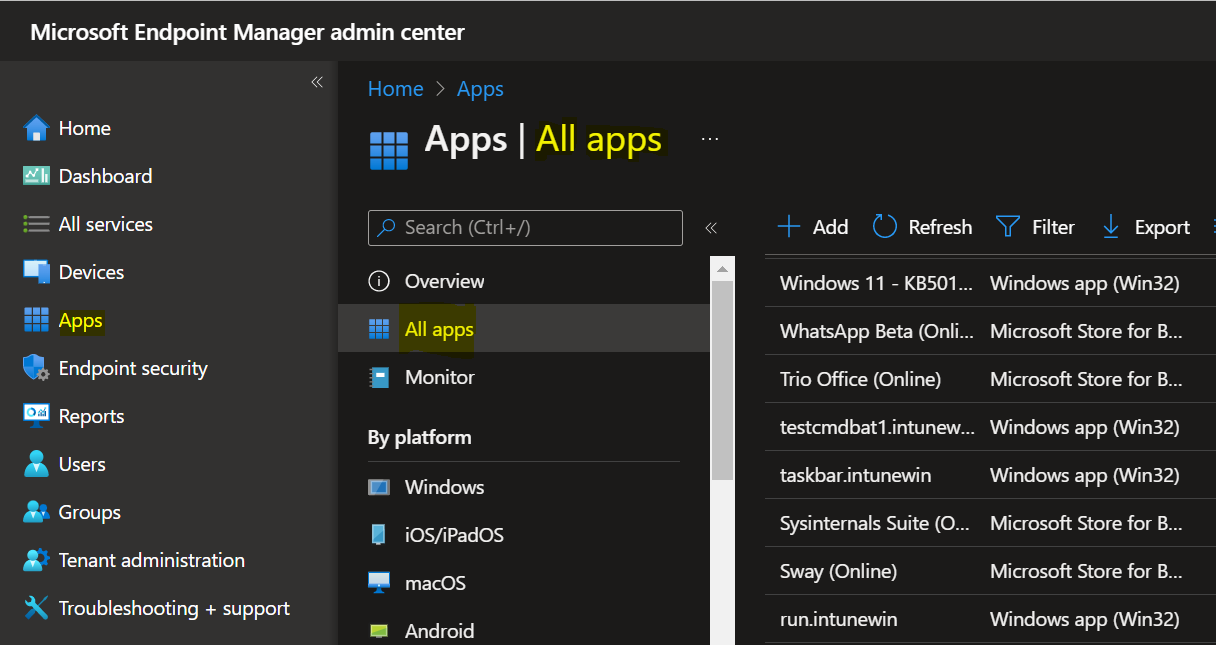
Click on Apps - Delete Application Deployment from Intune MEM Portal 1
Click on Apps – Delete Application Deployment from Intune MEM Portal 1

You can use the Columns property to validate whether the application has been assigned. Once you have deployed an application, you can see the Assigned column showing the status Yes

Note – If you do not see the Assigned column, You can click on the Columns to add or remove columns. Select Assigned columns.
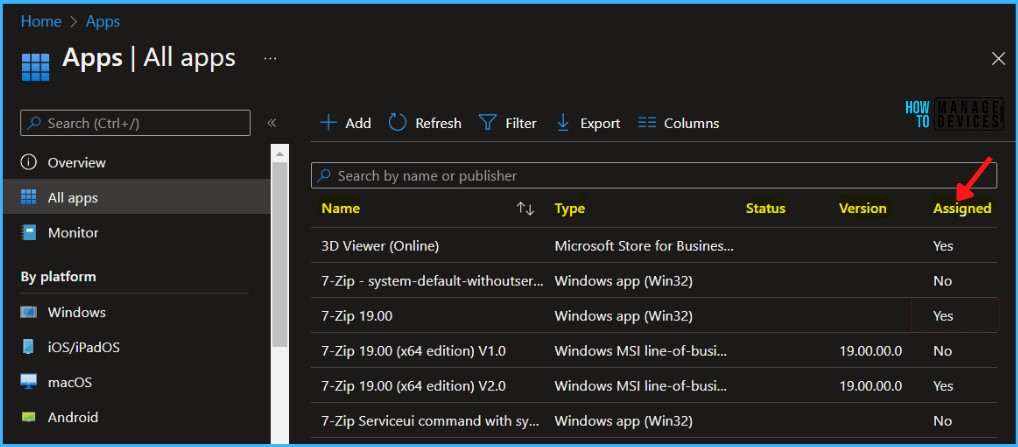
Apps Assigned - Delete Application Deployment from Intune MEM Portal 2
Apps Assigned – Delete Application Deployment from Intune MEM Portal 2

Select the existing application from the list if you want to delete the deployment. Select the application and select Properties. Scroll down and click on Edit in the Assignments.
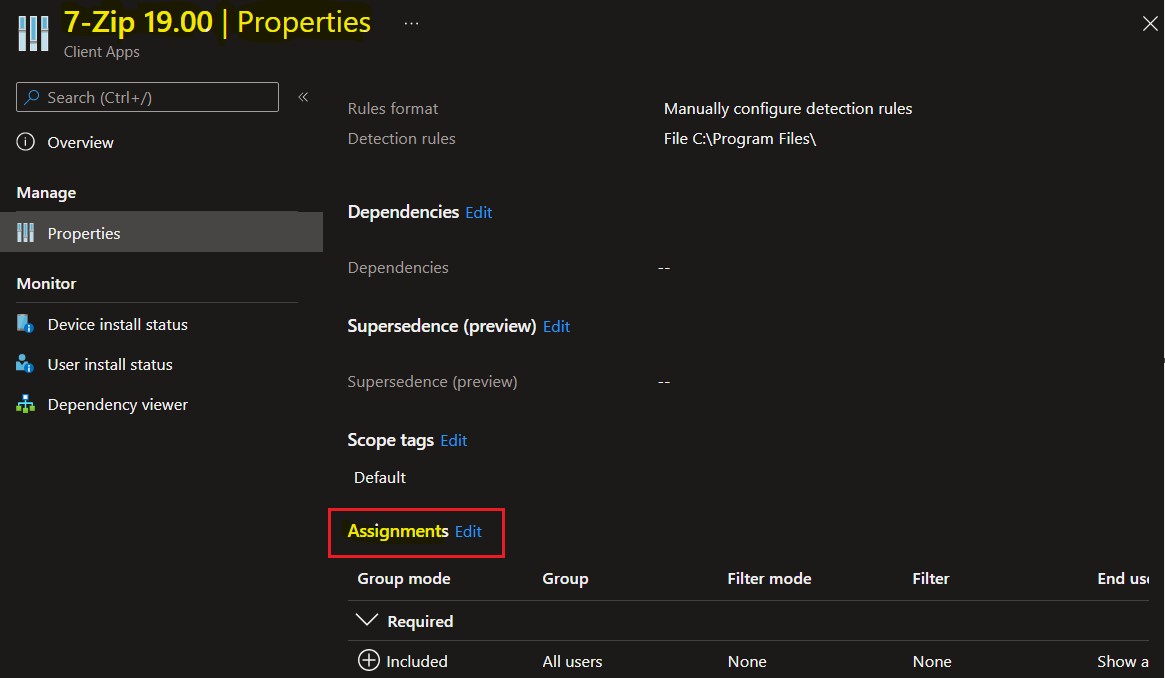
Apps Assignments - Delete Application Deployment from Intune MEM Portal 3
Apps Assignments – Delete Application Deployment from Intune MEM Portal 3

Based on assignments, Select three dots at the end of the row next to the Delivery optimization priority and choose Delete. If want to remove the assignment completely, ensure the app assignment is deleted from all the modes.

Note – App availability can be set based on the assignment type. Assignment type can be RequiredAvailable for enrolled devices, or Uninstall.
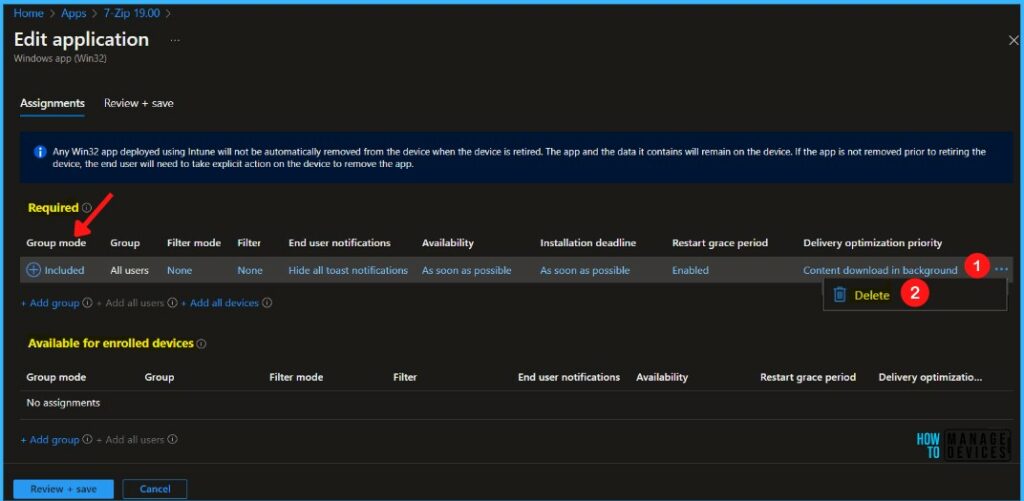
Assignments - Delete Application Deployment from Intune MEM Portal 4
Assignments – Delete Application Deployment from Intune MEM Portal 4

The next screen will appear with the Summary, Review the selection and click Save. A notification will appear automatically in the top right-hand corner with a message “Application “7-Zip 19.00” saved successfully.”
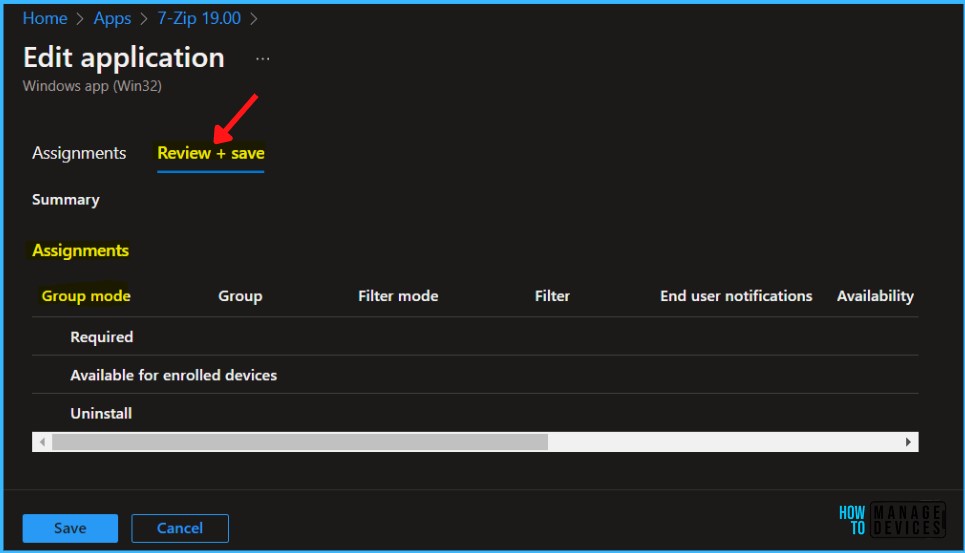
Review + Save - Delete Application Deployment from Intune MEM Portal 5
Review + Save – Delete Application Deployment from Intune MEM Portal 5

Once you successfully removed all assigned deployments, You can see the Assigned column showing the status No in the apps pane.
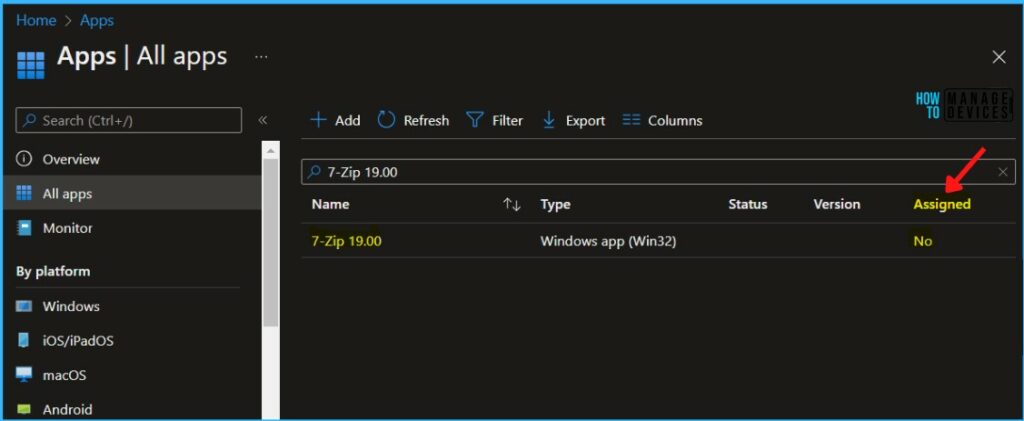
Apps Assignment - No | Delete Application Deployment from Intune MEM Portal 6
Apps Assignment – No | Delete Application Deployment from Intune MEM Portal 6

Once the app assignment is removed, the assigned application in intune company portal will automatically be removed. When the devices check-in with the Intune service.

Author

Written by

Jitesh has over 5 years of working experience in the IT Industry. He writes and shares his experiences related to Microsoft device management technologies and IT Infrastructure management. His primary focus area is Windows 10 Deployment solution with Configuration Manager, Microsoft Deployment Toolkit (MDT), and Microsoft Intune.

Discussion

Join the discussion

Your email address will not be published. Required fields are marked *

Related guides

Intune

Simplify Windows Devices to Run Only the Required Applications using Intune

Key Takeaways Hey, let’s learn about Simplify Windows Devices to Run Only the Required Applications using Intune. This policy lets administrators replace the default windows shell with a custom or lightweight shell. it improves performance by using system resources and is useful for devices that run a dedicated application. If the policy is disabled or […]

AC Anoop C Nair 8 min read
Intune

Enhance macOS Compliance with Custom Security and Compliance Checks to Improve Device Security using Microsoft Intune

Key Takeaways In this post we are discussing about Enhance macOS Compliance with Custom Security and Compliance Checks to Improve Device Security using Microsoft Intune. Microsoft has announced the general availability of Custom Compliance Settings for macOS in Microsoft Intune. The feature helps organizations strengthen security controls while supporting many types of macOS management scenarios. […]

AC Anoop C Nair 4 min read
Intune

Manage Samsung Galaxy Firmware Versions to Improve Security and Compliance using Microsoft Intune

Key Takeaways In this post we are discussing Manage Samsung Galaxy Firmware Versions to Improve Security and Compliance using Microsoft Intune. Microsoft Intune has received a new update that expands firmware management capabilities for Samsung Galaxy devices through Firmware Versionsintegration. This enhancement gives IT administrators more control over firmware and operating system updates, helping them […]

AC Anoop C Nair 4 min read
Intune

MS Intune Adds Windows Registry Data Collection to Device Inventory for Single Values All Key Values and Subkeys

Key Takeaways Microsoft Intune 2607 introduces Windows Registry Data collection in Device Inventory, allowing IT admins to verify actual device configurations without relying on custom discovery or remediation scripts. Using the Properties Catalog, admins can collect registry information through Single Value, All Values Under a Key (Non-Recursive), or Same Value Across Subkeys. MS Intune Adds […]

AC Anoop C Nair 5 min read