





How to Secure Your Servers from Critical LogScale Vulnerability
Key Takeaways
- CrowdStrike found a serious LogScale issue that lets attackers access server files without logging in.
- It affects some self-hosted versions, but SaaS users are already protected and Next-Gen SIEM users are not affected.
- No attacks have been seen, and the problem was found during internal testing.
- Users with self-hosted setups should update quickly and check for any past unauthorized access.
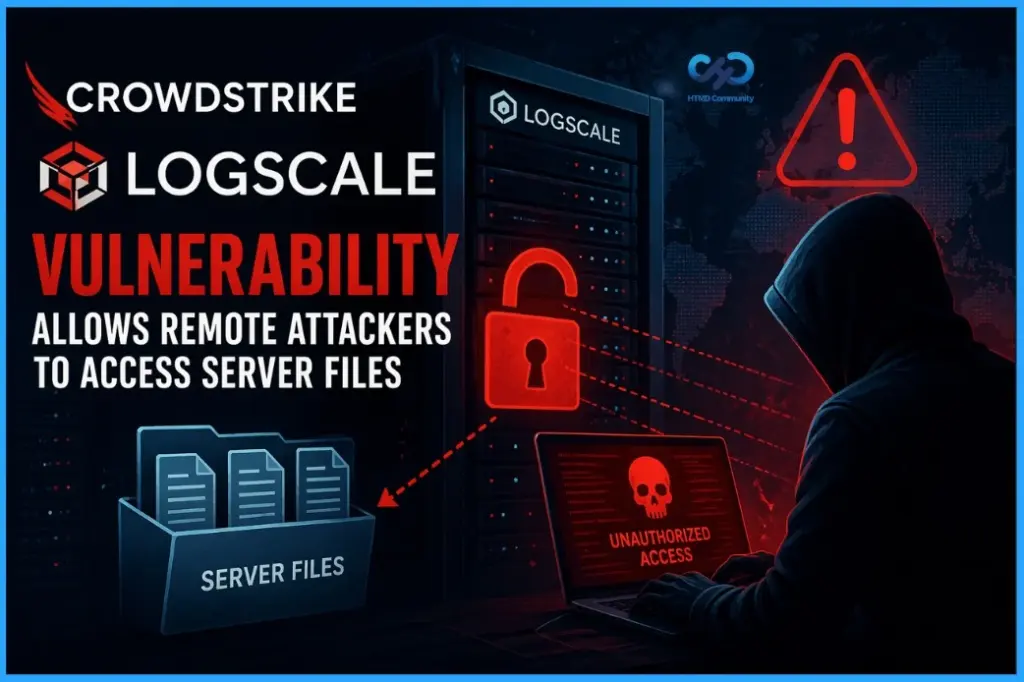
Hey, let’s discuss how to secure your servers against the critical LogScale Vulnerability. CrowdStrike has issued an urgent advisory regarding a critical vulnerability, CVE-2026-40050, affecting its LogScale platform. The issue is an unauthenticated path-traversal flaw found in a specific cluster API endpoint, which, if exposed, allows a remote attacker to access arbitrary files from the server’s filesystem without requiring authentication.
Table of Contents
How to Secure Your Servers from Critical LogScale Vulnerability
The vulnerability has been assigned a CVSS v3.1 score of 9.8 (Critical), highlighting its serious impact. It enables attackers to traverse the server’s directory structure and read sensitive files, posing significant risks to confidentiality, integrity, and availability.
| Two Weakness Types Underpin this Vulnerability |
|---|
| CWE-306 – Missing Authentication for Critical Function |
| CWE-22 – Improper Limitation of a Pathname to a Restricted Directory (Path Traversal) |
- 4 Key Ways Microsoft Intune Helps Reduce Vulnerability Risk and Improve Security Posture
- April 2026 Security Update | Critical and High-Risk Vulnerabilities You Must Patch Immediately
- Windows 11 KB5063878 KB5063875 August 2025 Patch and 1 Zero Day Vulnerability and 107 Flaws
Impact and Current Status
The vulnerability affects LogScale Self-Hosted GA versions 1.224.0 through 1.234.0 (inclusive), as well as LogScale Self-Hosted LTS versions 1.228.0 and 1.228.1. Next-Gen SIEM customers are not affected and do not need to take any action. For LogScale SaaS customers, CrowdStrike deployed network-layer blocks across all clusters on April 7, 2026, mitigating the risk at the infrastructure level, and a review of log data found no evidence of exploitation.
There is currently no indication of active exploitation, and the vulnerability was discovered internally through continuous product testing rather than by an external researcher or real-world attack. CrowdStrike is continuing to monitor LogScale SaaS environments for any signs of abuse or suspicious activity related to this issue.

Mitigations
Self-hosted LogScale customers are advised to upgrade immediately to patched versions, including 1.235.1 or later, 1.234.1 or later, 1.233.1 or later, or 1.228.2 (LTS) or later. CrowdStrike confirmed that these updates do not introduce any performance impact, and organisations should also follow standard incident response practices to check for any signs of prior unauthorised access or file exfiltration.
Read More – April 2026 Security Update | Critical and High-Risk Vulnerabilities You Must Patch Immediately
Need Further Assistance or Have Technical Questions?
Join the LinkedIn Page and Telegram group to get the latest step-by-step guides and news updates. Join our Meetup Page to participate in User group meetings. Also, join the WhatsApp Community and the Whatsapp channel to get the latest news on Microsoft Technologies. We are there on Reddit as well.
Author
Anoop C Nair has been Microsoft MVP for 10 consecutive years from 2015 onwards. He is a Workplace Solution Architect with more than 22+ years of experience in Workplace technologies. He is a Blogger, Speaker, and Local User Group Community leader. His primary focus is on Device Management technologies like SCCM and Intune. He writes about technologies like Intune, SCCM, Windows, Cloud PC, Windows, Entra, Microsoft Security, Career, etc
Discussion