






Enable Disable Search to Use Location Policy using Intune
Hai, Let’s discuss Enable Disable Search to Use Location Policy Deployment through Intune Setting Catalog. As you all know, the catalog settings are some of the best features in Intune. Our previous posts discussed the different types of setting catalog policies.
Now, we will focus on deploying the Enable/Disable Search to Use Location policy. As users, we need to manage the location settings and prioritize search options from time to time. Users can enjoy various benefits that enhance convenience and efficiency by allowing access to location data.
Utilizing location information is a crucial aspect of facilitating a smooth experience when using features in search engines and digital assistants like Cortana. So, when in a new city, having access to location data allows us to find the places we want to visit, and location searches are really helpful for us.
Search and Cortana can access your location to provide personalized results in this policy. They can use your location to offer services such as local weather updates or nearby restaurant recommendations if enabled. If disabled, they won’t have access to your location.

Table of Contents
What Happens when you Enable Search to Use Location?
If you want to give users a more personalized experience based on their location, this can be useful for people who often use location-based searches and Cortana features. If this is turned on, search and Cortana can access location information.
Enable Disable Search to Use Location – CSP Details
In the previous discussion, we discussed the various benefits of using search for locations and the importance of setting catalog policies for users. Now, we will focus on an important aspect of this policy: its CSP details. CSP details are crucial for Intune.
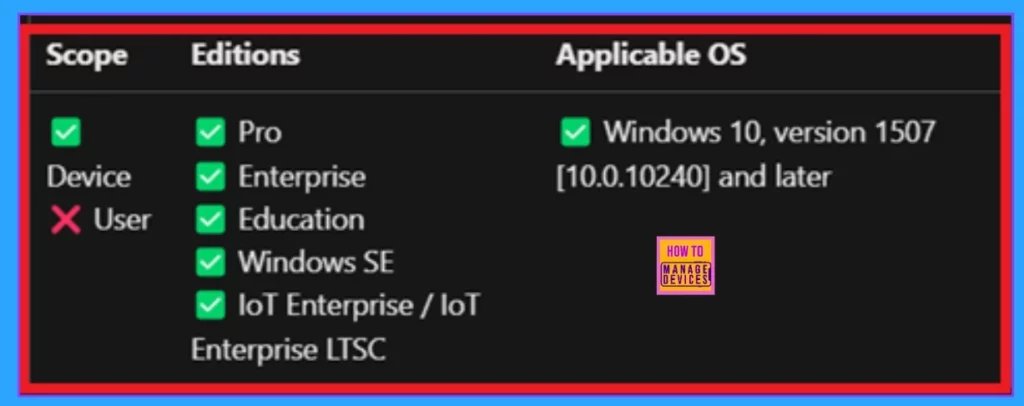
Specifically, CSP refers to configuration and service providers that assist in managing settings on Windows devices. The important information related to CSP will be provided in the table and screenshot below.
| Scope | Editions | Applicable OS |
|---|---|---|
| Applicable to the Device | Pro | Windows 10, version 1507 [10.0.10240] and later |
| Not applicable for User | Enterprise | |
| Education | ||
| Windows SE | ||
| IoT Enterprise / IoT Enterprise LTSC |
- Search Options in Group Policy and Intune Cloud Policy
- Enable Offline Maps Auto Update using Intune Setting Catalog Policy
- Enable Fast First Sign In Policy under Authentication in Intune Settings Catalog
Create Profile
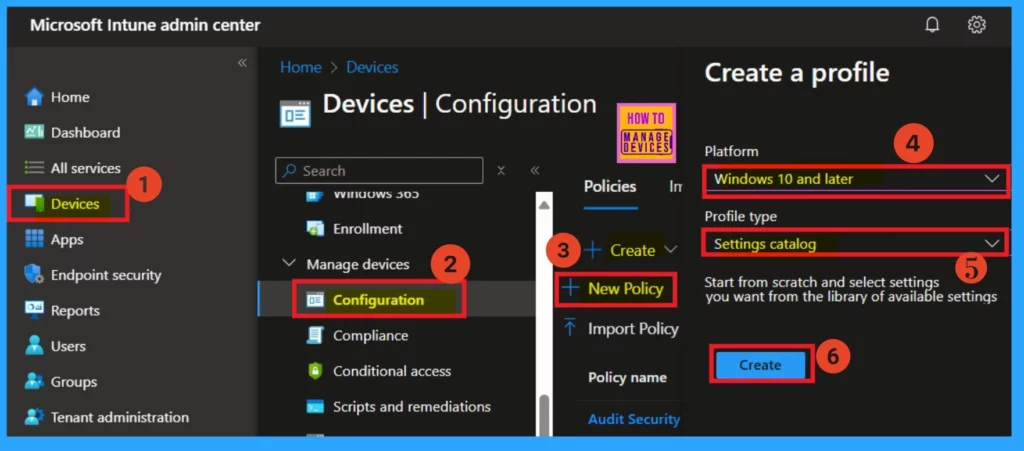
To create a profile, first log in to the Microsoft Intune admin center. Once you’re signed in, navigate to Devices> Configurations > Create > New Policy. This will open a new window called “Create a Profile.” In this window, you can select the platform, which should be Windows 10 and later. Choose the profile type as Settings Catalog.
- Finally, you can create the profile by clicking the “Create” option.
Basics
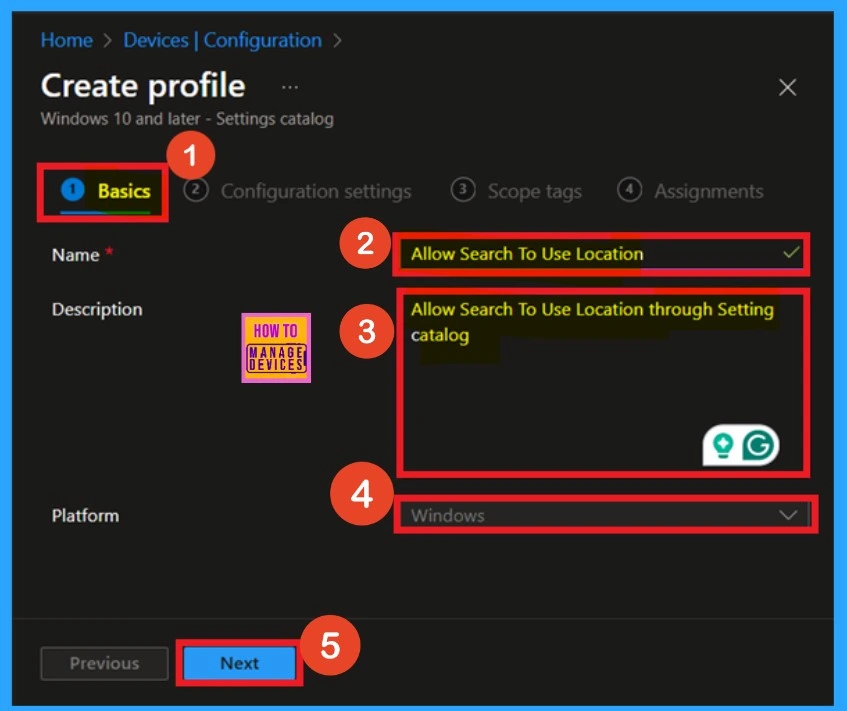
The next step is the Basics. This is the first action you need to take. You can provide the basic details of the policy, including the name, description, and platform. I have named the policy “Allow Search to Use Location,” you should also include a description of this policy to help understand its purpose in the future.
- There is no need to select the platform, as it is already set to Windows.
- Click on Next to proceed.
Configuration
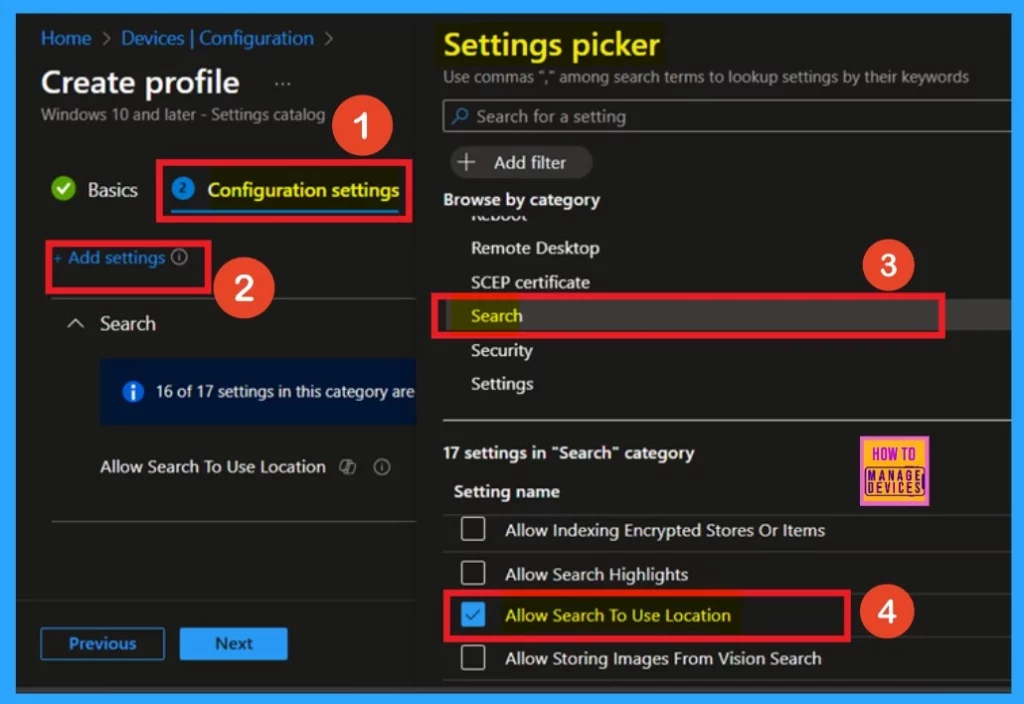
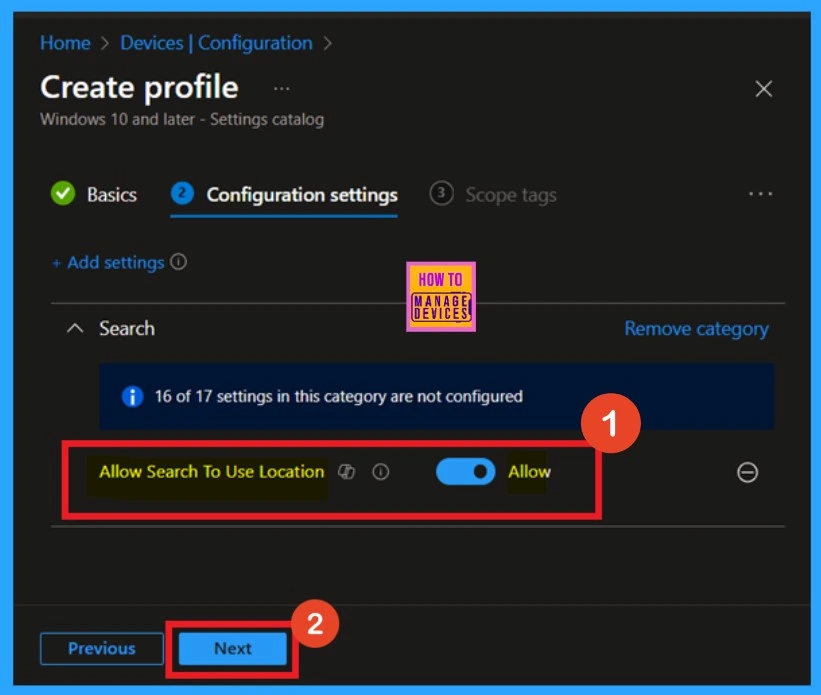
After the basics, you are in the Configuration tab settings, which is an important section. Here, you can add settings to the policy. Look for a hyperlink labelled Add Settings and click on it. This will open a new window called “Settings Picker.” In the Settings picker window, scroll down to the category labelled Search.
When you click Search, you’ll see a list of available settings. Select the desired setting; I have chosen “Allow Search to Use Location.” After making your selection, you can close the Settings Picker window.
After closing the settings picker, you will be directed to the configuration settings page. Here, you can see an option to allow the search to access your location. On this page, you can enable or disable the policies.
- To Enable a policy, toggle the pane from left to right.
- To turn it off, toggle the pane from right to left.
- Once you have made your selections, click on “Next.”
Scope Tags
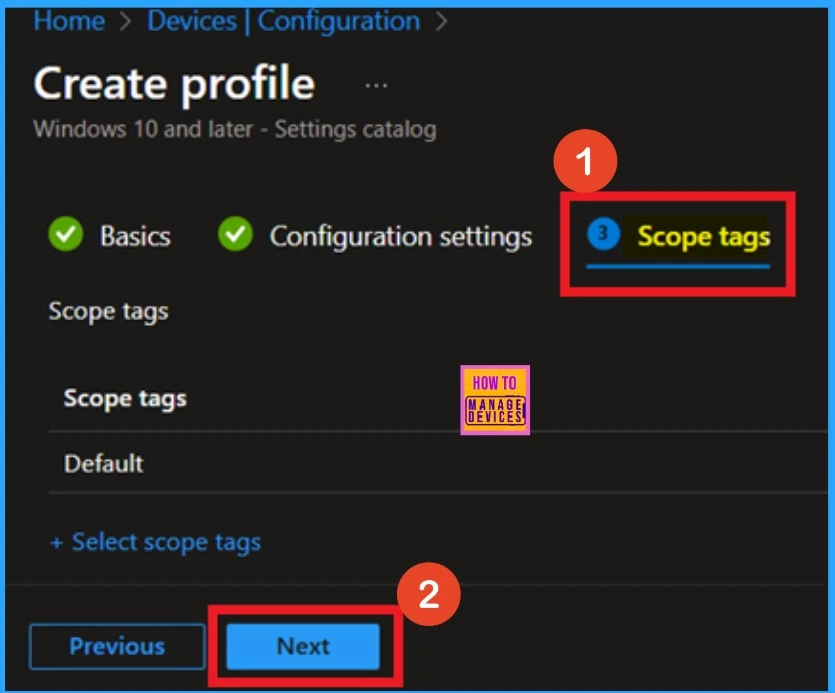
The next step is adding scope tags to the policy. An option labelled “Select Scope Tags” appears as a hyperlink. When you click on it, you can select all the relevant scope tags to add to the policy. I decided to skip this section and clicked on Next.
Assignments
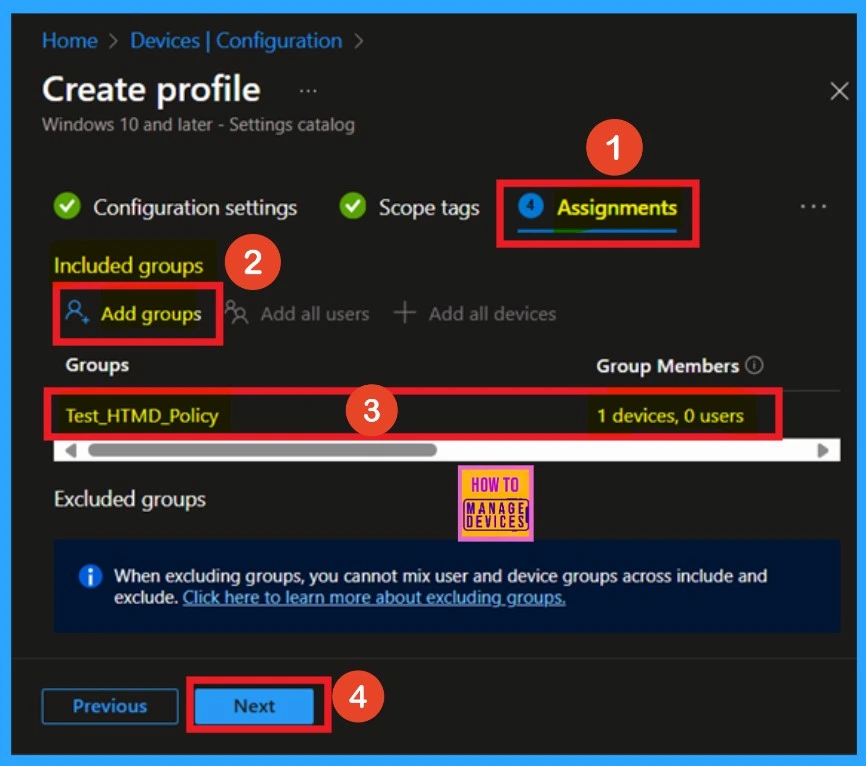
The next tab is “Assignments.” This section is very important, similar to the configuration settings. Here, you can assign specific groups to the policy you are creating. Click “Add Groups” under the Include section, then select the group you want the policy to apply to. I chose the group to which I wanted to deploy the policy and clicked Next.
Review + Create
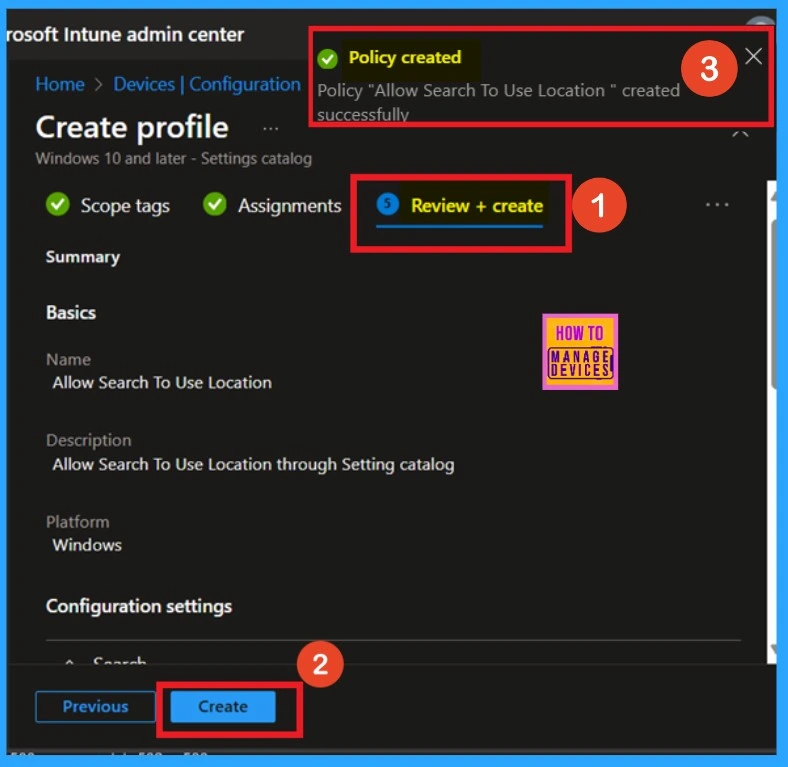
This section’s final step in creating a policy is Review + Create. You don’t need to do anything. It’s just a summary page. It shows the basic details description and the configuration settings details, etc. If you have any changes, go back to the previous tab, and you can easily change them. Click on the Create option. Now, you will get a notification that that policy search to use location was created successfully.
Monitoring Status
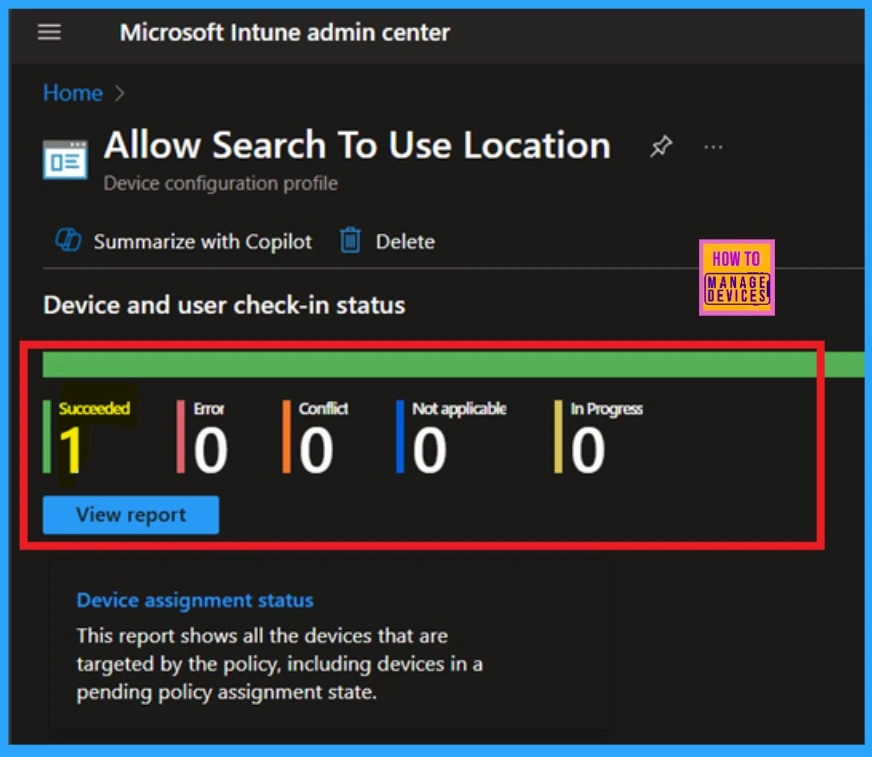
After creating the policy, you have to check the monitoring status. It is important to confirm whether the policy has been created successfully. You will need to wait 8 hours to know if the policy creation is successful or not. However, using the company portal sync option, you can reduce this waiting period.
In the monitoring status, you will see whether the policy creation succeeded. To check the monitoring status, go to the Device> Configuration and search for the specific policy you created. Click on it to view the policy’s overview (monitoring status).
Client Side Verification
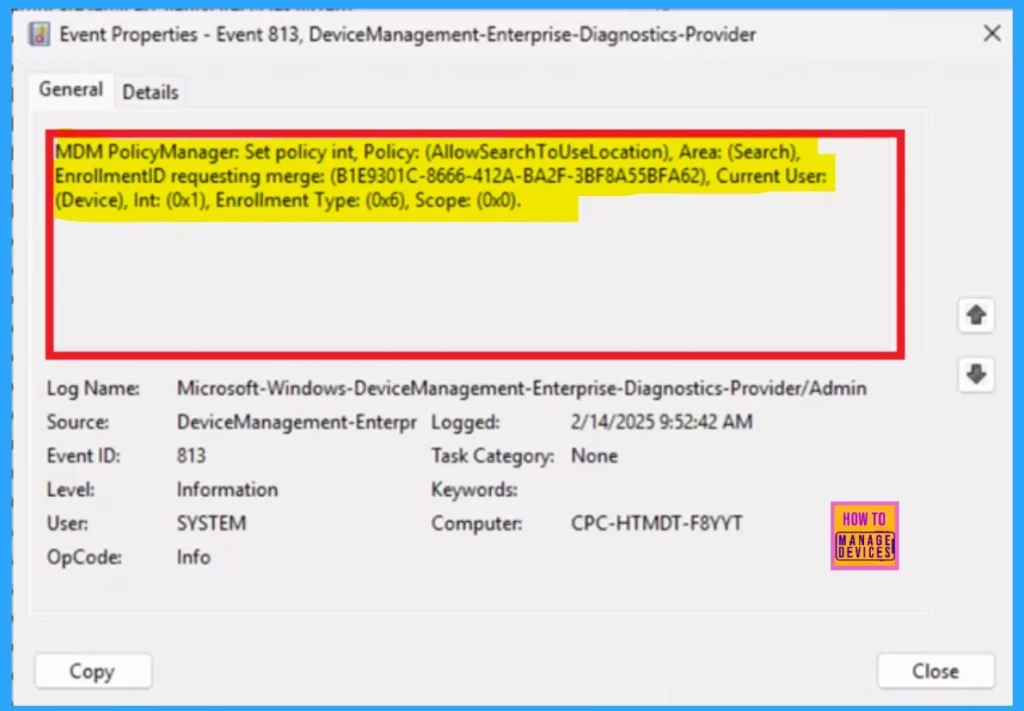
You can check the client-side status using the Event Viewer. Go to Applications and Services Logs > Microsoft > Windows > Devicemanagement-Enterprise-Diagnostics-Provider > Admin. Look for Event ID 813 or 814, which indicates a successful result. You can use the filter option to search for quick results.
| Policy Details |
|---|
| MDM PolicyManager: Set policy int, Policy: (AllowSearchToUseLocation), Area: (Search), EnrollmentID requesting merge: (B1E9301C-8666-412A-BA2F-3BF8A55BFA62), Current User: (Device), Int: (0x1), Enrollment Type: (0x6), Scope: (0x0). |
Need Further Assistance or Have Technical Questions?
Join the LinkedIn Page and Telegram group to get the latest step-by-step guides and news updates. Join our Meetup Page to participate in User group meetings. Also, Join the WhatsApp Community to get the latest news on Microsoft Technologies. We are there on Reddit as well.
Author
Anoop C Nair has been Microsoft MVP from 2015 onwards for 10 consecutive years! He is a Workplace Solution Architect with more than 22+ years of experience in Workplace technologies. He is also a Blogger, Speaker, and leader of the Local User Group Community. His primary focus is on Device Management technologies like SCCM and Intune. He writes about technologies like Intune, SCCM, Windows, Cloud PC, Windows, Entra, Microsoft Security, Career, etc.


Discussion